The 2-3-5 Pyramid: History of Football’s First Great Formation
The 2-3-5 Pyramid: Football’s First Great Formation
Before football became a game of compact defensive blocks, pressing systems, and tactical overloads, the sport belonged to attackers.
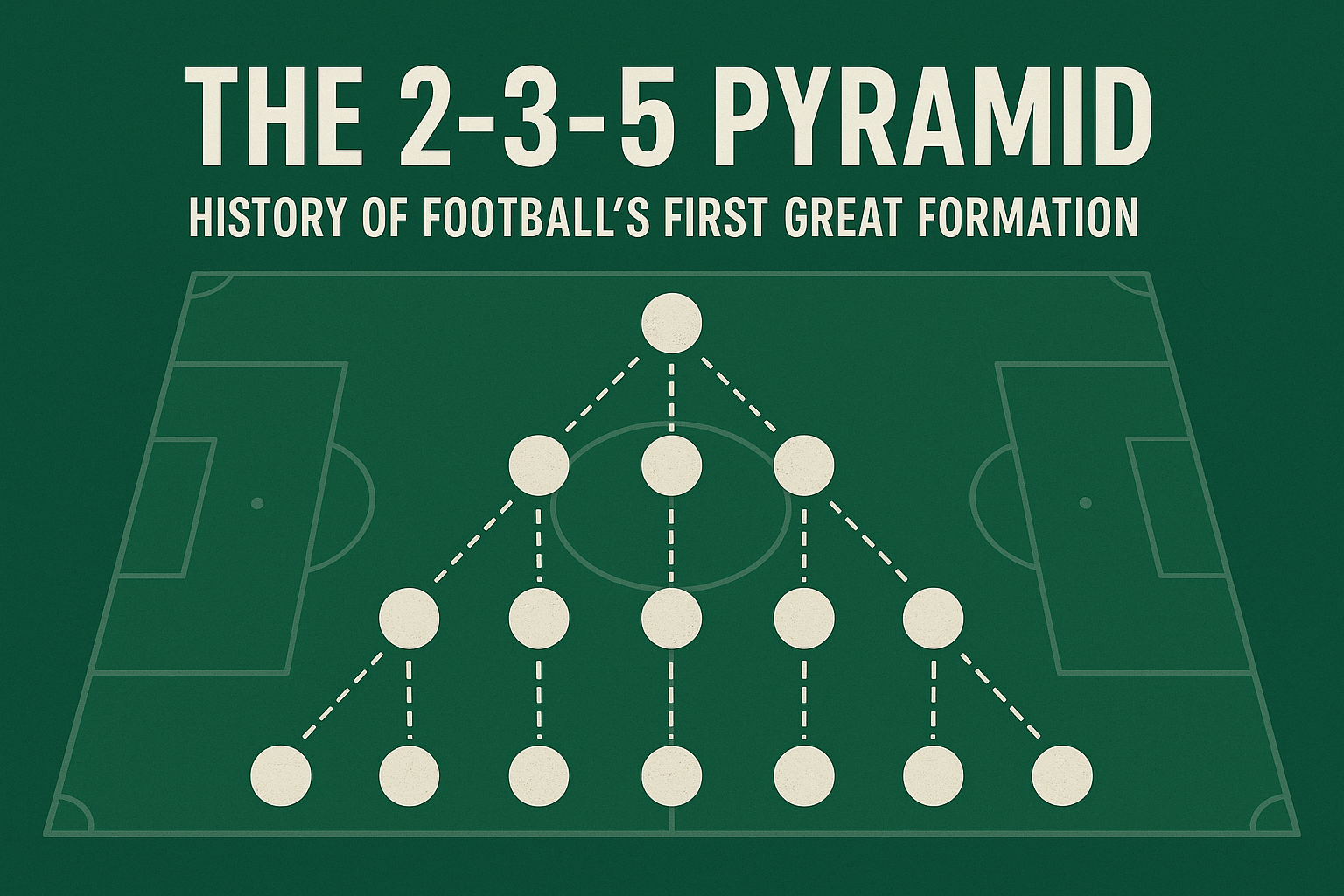
In the late 19th and early 20th centuries, the dominant tactical shape was the 2-3-5 formation — famously known as “The Pyramid.” It was football’s first true strategic system, and although it now looks wildly unbalanced by modern standards, it laid the foundations for positional play, spacing, and attacking structure.
At a time when defending was far less organized, the Pyramid prioritized one thing above everything else: overwhelming the opposition with numbers high up the pitch.
Why the 2-3-5 Emerged
Football in its earliest years was chaotic. Teams often played with little positional discipline, and matches resembled waves of dribbling attacks rather than coordinated tactical systems.
As passing football slowly evolved, teams began searching for structure. The answer became the 2-3-5:
- 2 full-backs
- 3 half-backs
- 5 forwards
The shape naturally formed a pyramid across the pitch, giving the formation its famous nickname.
The Five-Man Forward Line
The most striking feature of the Pyramid was its attacking line. Modern football typically uses one striker or three forwards. The 2-3-5 used five.
These players occupied two wide wings, two inside-forward positions, and a central striker role. The setup stretched defenses across the entire width of the pitch and created relentless attacking pressure.
Width became a tactical weapon for the first time, forcing opponents to defend spaces they had rarely considered before.
The Role of the Half-Backs
Behind the forwards sat the three half-backs, arguably the formation’s most important tactical innovation.
These players acted as ball winners, distributors, and transitional links between defense and attack. In many ways, they became the ancestors of the modern midfield.
The centre-half role was especially influential, eventually evolving into positions similar to the modern centre-back and defensive midfielder.
Why Defending Was Different
To modern audiences, the 2-3-5 appears dangerously aggressive. Only two defenders regularly remained behind the ball, leaving massive spaces exposed during transitions.
But football at the time moved at a slower tactical speed. Teams lacked today’s pressing systems, athletic conditioning, and rapid counterattacking structures.
Defensive organization was also far more man-oriented than zonal, leading to open, high-scoring matches filled with constant attacking exchanges.
The Decline of the Pyramid
As football evolved, the Pyramid’s weaknesses became increasingly obvious. Midfield spaces were vulnerable, transitions became more dangerous, and teams began searching for stronger defensive balance.
Changes to the offside law in the 1920s accelerated this tactical shift and eventually helped give rise to Herbert Chapman’s famous W-M formation.
The W-M didn’t simply replace the Pyramid — it reshaped football strategy entirely.
The Legacy of the 2-3-5
Although no elite side would use the Pyramid today, its influence still exists throughout modern football.
The formation introduced concepts that remain central to the sport:
- Attacking width
- Positional spacing
- Passing triangles
- Structured movement
The 2-3-5 Pyramid may now look outdated, but it helped transform football from a chaotic game into a tactical one.
← Return to our main guide: The Evolution of Football Tactics: Formations & Pressing