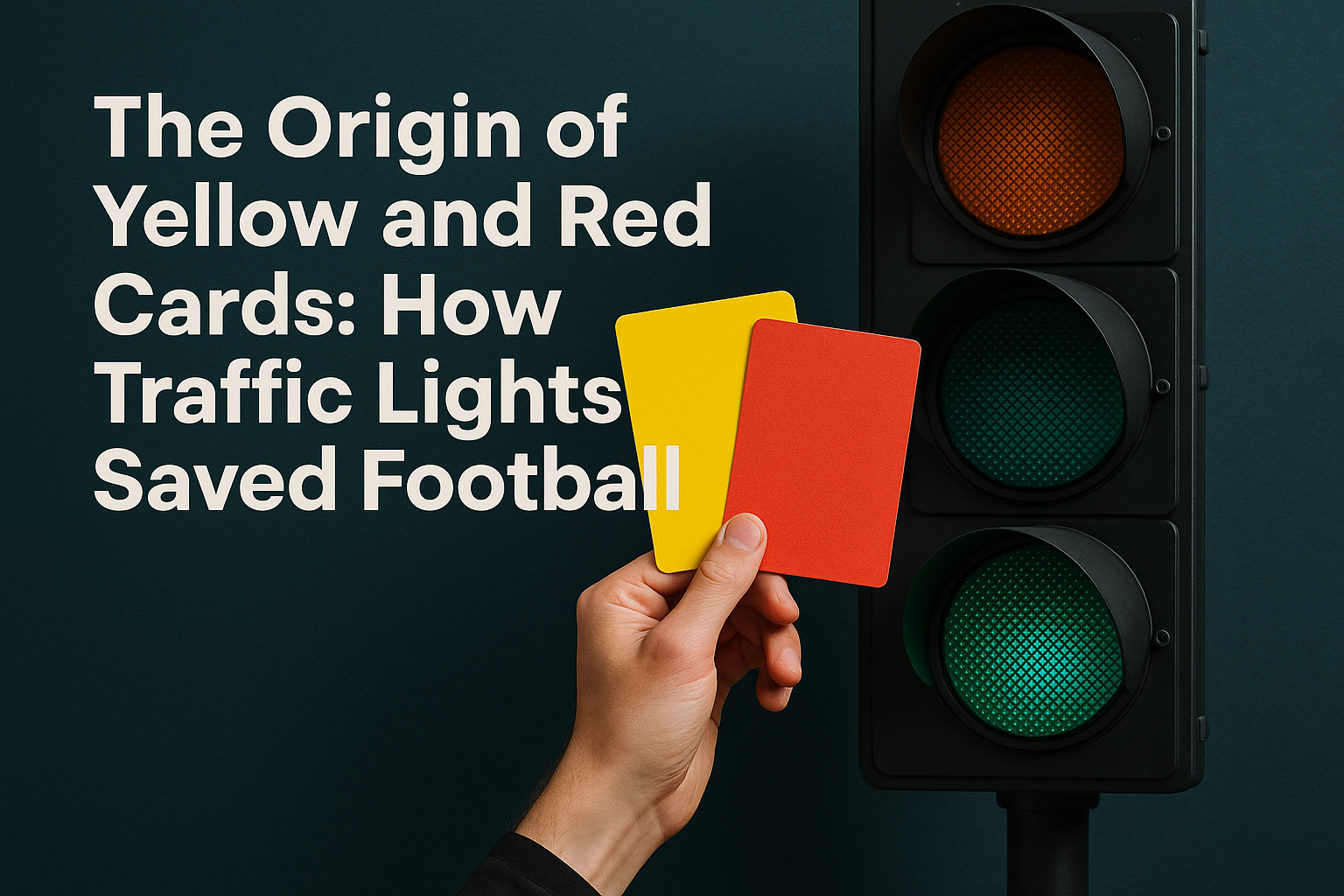
The Origin of Yellow and Red Cards: How Traffic Lights Saved Football
Modern football discipline is built on two simple signals. A yellow card is a warning. A red card is the end. No arguments, no confusion, no need for translation.
It’s so familiar now that it feels like it’s always existed. But before 1970, referees were managing international football with a system that was anything but clear — and it was starting to fall apart on the biggest stage.
The turning point came at the 1966 World Cup at Wembley. Not through a rule change or a committee decision, but through a match that exposed just how fragile referee communication had become.
1. Wembley 1966 and the Point of Breakdown
The quarter-final between England and Argentina is remembered less for the football and more for the fallout. Referee Rudolf Kreitlein struggled to control the game in a storm of language barriers and rising tension.
When Argentina captain Antonio Rattín was dismissed, he refused to leave the pitch for several minutes, insisting he hadn’t properly understood the decision. The situation exposed a deeper issue — authority that could not be clearly communicated was authority that could be resisted.
It wasn’t just confusion. It was control breaking down in real time.
The problem football couldn’t ignore
- Language barriers: Decisions were being lost in translation at the highest level.
- Delayed compliance: Players were not always clear when cautioned or dismissed.
- Loss of control: Referees had authority, but not instant understanding.
The issue wasn’t the laws of the game. It was the lack of a shared language for enforcing them.
2. The Traffic Light Idea
Ken Aston, chair of FIFA’s referees committee, left Wembley with the problem still unresolved in his mind.
Later that day, driving through London traffic, he stopped at a junction and watched the lights change from amber to red.
That simple sequence became the foundation of a system football didn’t know it needed.
Simple, instant, universal
- Yellow (amber): A warning — behaviour has crossed the line.
- Red: Stop — no debate, no continuation, immediate dismissal.
- No language required: A decision understood instantly by everyone.
It solved the one problem football had failed to fix: making discipline visible the moment it was given.
3. 1970: The System Goes Global
The card system was introduced at the 1970 World Cup in Mexico. For the first time, refereeing discipline became visual rather than verbal.
There was no ambiguity. When the referee raised a card, the decision was understood instantly by players, managers, and supporters alike.
It changed the rhythm of authority on the pitch. Referees no longer needed to explain decisions — they simply showed them.
What the cards changed
- Player behaviour became more controlled due to visible consequences.
- Referees gained instant authority without verbal confrontation.
- Match control improved through clarity rather than escalation.
4. How Discipline Changed the Way Football Is Played
The introduction of cards didn’t just tidy up refereeing. It changed how teams approached the game itself.
Defenders could no longer rely on repeated tactical fouling without consequence. Attacking players gained a level of protection that simply hadn’t existed before.
Over time, even coaching methods adapted. Managing bookings became part of match strategy, particularly in high-stakes fixtures.
What began as a communication fix slowly reshaped tactical behaviour across the sport.
5. The Law of the Game Becomes Visual
The system expanded naturally over time, extending beyond players into technical areas and bench behaviour.
The principle stayed the same: discipline only works when it is seen, not explained.
That’s why the system has endured. It removed interpretation from one of football’s most contested areas.
Final Verdict
The yellow and red card system didn’t emerge as a tactical revolution. It began as a solution to confusion at Wembley in 1966 and became one of football’s most important global standards.
Ken Aston didn’t just improve refereeing. He removed ambiguity from authority itself.
And in a sport where pressure is constant and interpretation is everything, that clarity remains one of football’s most important foundations.